Ellie Searl Stories

4/27/2013

GANESH AT THE DOOR


 . . . AKA Our Move to Delaware

A
fter a thirty-five-year career as a Unitarian minister, my husband Ed decided to change his life direction. He was ready for no more church: no more hospital visits, no more evening meetings, no more sermonizing, counseling, and funerals.
     I agreed. I was also ready. Not that I didn't like church.  I did.  Ed made church interesting. But I suffered minister’s wife guilt, especially when I ducked Sunday services, potlucks, Friday Fun Nights, Third Tuesday Movies, and coffee hour.
So in October of 2011, Ed submitted his resignation as minister of the Unitarian Church of Hinsdale beginning January 1, 2013. Christmas Eve would be his last service, and December 31 would be his last day. 
Ed had a plan.  His mom and dad, Mary and Clint, then 95 and 96 years old, were becoming frail, and Ed wanted to live with them so they could stay in their home— the one they built when Ed was a baby—for the remainder of their lives.  It was the right thing to do. It would doubtless include hospital visits, counseling, and maybe even funerals, but we figured a congregation of two would be easy to manage.


***

Moving in with Ed's parents was a long way off.   Fourteen months. Plenty of time to get our household items sorted, donated, recycled, and packed.  Plenty of time to update the house, stage it, sell it, move to Delaware, and care for the elderly.  
But from October to the next July, we did nothing. We talked about it.  We thought about it.  We even looked forward to it.  But we did nothing, as though we expected the Relocation Fairy to burst through our inertia and take action.
  I continued designing books, Ed continued ministering, and we both continued drinking champagne on Sunday afternoons, riding kick bikes in Oak Park, eating tacos at La Cabanita, and taking walking tours of the city.  But get the house ready?  Nothing.
Friends would ask. "Is your house on the market?" - "Are you unloading stuff?" - "Need boxes?"
Our answers were the same.  "No." - "No." - "Not yet."
We were in denial.  At least I was.  Maybe I didn't think it was real.  Having lived in La Grange, Illinois, for 30 years, it didn't seem possible that I'd be leaving.  I couldn't imagine myself not being in these rooms or using that sink or climbing those stairs.  So I ignored what I had to do.
Every now and then Ed would say, "El, we have to do something about the house."
I’d say, "Today isn’t really good for me.”

***

As the summer of 2012 approached, we decided to spend the month of July with Ed's parents to test the elder care situation.  Still having done nothing with the house, we loaded our technology and a month’s worth of clothes into a big black Enterprise Toyota Avalon—leather seats, Sirius, and On-Star, which I promised not to play with like before when I declined emergency services after I  apologized to the agent for the accidental crisis call—and headed to Delaware.
A month with Mom and Dad was somewhat enjoyable, somewhat frustrating, somewhat humorous, and somewhat worrisome.  Ed and I took care of Mom and Dad—shopping, cooking, helping, conforming—and when we were off duty, took drives into the country, explored the neighborhoods, walked the nature preserve, and found fun restaurants.
We worked as a team as we maneuvered in and out of the parents' habits and schedules. We laughed privately at the ridiculousness of some things and vowed never, ever, to be like that when we are timeworn and frail.

***

Mary and Clint are as sweet and lovable as two people can be when they're reaching the edge of life. And like many elders, they live in the past with stories of growing up on the farm when the world was "far better than it is today," and they live in the present with unyielding routines, rules, and recriminations.

¨     Only one box of ice cream open at a time.  Even if you don't like it so much. 
*    "You shouldn't have opened that. The Banana Peanut Butter Mint isn't finished."
¨        The mayonnaise goes behind the coffee, not in front of it.  
*   "I couldn’t find the mayonnaise today. I don't want to make a sandwich and find out I've spread my roll with coffee grounds!" 
¨        No keys to the house for us.  
*        "You might lose them." 
¨        Air conditioner - 81 degrees.   
*        "Wait 'til you're 96, you'll see."
¨        Breakfast - 7:00, lunch - 11:30, supper - 5:00. 
*        "It's almost 5:00 and nothing's happening in the kitchen."
¨        No snacking between meals. 
*   "You shouldn't be eating those crackers. Supper is only a couple of hours away."
¨        Early light meal on Saturday. No eating later.
*        “The kitchen closes at 5:00. Period.” 
¨        Don't lift the Dirt Devil off the floor. 
*        "I'm not fussy.  I just want it done my way." 
¨        Wash all the Baggies. Hang them up. 
*        "You’re so wasteful." 
¨    Buy exactly and only what's on the grocery list, which is determined by what’s on sale. 
*        “You paid too much for that chicken, you know."
¨        No doing laundry on Sundays.  
*        "You've got all week to do laundry. Except Monday.  That's my day." 
¨        No cooking things for later at lunchtime. 
*        "It’s lunchtime. Not cooking time." 
¨        Bedtime at 7:00. 
*        "Wait 'til you're 96, you'll see."

Mary and Clint might live by routines, rules, and recriminations, but they find interest and joy in their projects.  Mom likes baking, doing the laundry, ironing with starch, reading the newspaper cover to cover, watching "Judge Judy," and marveling at the beauty of her back yard.  Dad takes care of the bills, loves genealogy, and makes sure the landscaping is up to par, even though he can't do it himself anymore.      And they love their dinner conversations about days long gone—stories of hobo Peg-legged Pete who clomped to Mom's farm each spring and fall to change his clothes and have a meal, or slaughtering pigs in November, or planting onions right after St. Patrick’s Day—each story accompanied by Mom’s coconut cream pie, or lemon sponge cake, or the one permissible ice cream.  
Ed and I kept our spirits high by listening, cajoling, laughing, and drinking. We had cocktails every afternoon at 4:00 as we prepared dinner. In the evenings, Ed and I read, wrote, or watched Hulu Plus videos on our Kindle Fires and iPad.  By the end of July, the double-sized bottles of vodka and bourbon were gone, and our Verizon bill was close to $500.
The month lasted what seemed like - well, a month.  Not so bad, really—almost doable. We figured we could keep our sanity and take care of the parents, so we drove home and calculated how long it would take us to sell the house. We had five months. 

***

Throughout August, we sorted some of our extraneous household items into keep, trash, and donate.  We packed a few boxes of office supplies.  We dumped junk onto the curb for Waste Management, but local pickers grabbed most of it first. We took stuff to Helping Hands and donated a sofa and an over-sized chair to Sharing Connections.  But we didn't do anything with our still-being-used household items.  And we didn't call a Realtor.
Then we had four months. The more we put it off, the more we panicked—and to avoid feeling panicked, we put it off.
In September, Ed began his last half-year of work, giving him less time to devote to the house.  I continued to write, design books, have lunch with clients, meet friends, go to movies, and ignore the house. 
By the last week in October, we had managed to clean and stage enough to ask a Realtor to help us put our house on the market.  We picked a top-notch Realtor—one with the best record in the Western Suburbs.  We figured that since we had put off this exercise in ignorance so long, we'd need the royalty of real estate to bring us to closure. But we knew that even she, with her selling wizardry, wouldn't be able to do the job in our time frame. Putting a house on the market in late October, hoping it would sell by the end of December was dumb, really dumb, especially given the collapsed market.
Ed and I expected to sign with this woman, after which we'd sit in a holding pattern for at least six months drinking coffee at Starbucks while potential buyers tromped through the place complaining about this or that or the other thing. And then, after putting in an offer, they'd want things repaired, changed, rewired, plastered, and plumbed.  We knew we’d be in one huge financial fix, shelling out several months' worth of mortgage payments after Ed’s paycheck had stopped coming in.
Of course, any potential sale could fail.  “I sell a house three times,” the Realtor said. “Once to the buyer, once to the bank, and once to the inspector. The sale could fall through at any stage.”
Our house-selling anxiety rose to a new high.
Also in October, Ed and I began planning for several events that were to take place before the end of the year.  One event was a late October trip to Cape Girardeau, Missouri, where I was to give a presentation on book design to the Southern Missouri Writers Guild.  
Then there were three BLESS-ED Events to celebrate Ed's 30-year tenure as minister: a concert on October 20, a testimonial on December 1, and Ed and Ellie's Diner on December 16.  Each celebration would be a huge party with music, speaking, hors d’oeuvres, and champagne. All ending with Christmas Eve—the big tearjerker—Ed's final service.
And I needed new clothes.
Throughout the month of October, I shopped for outfits at Veni Vidi Val’s in downtown La Grange. The owner, Val, and I had become good friends over the years, and her store was my place to shop.
On October 24, the day before Ed and I were to leave for Southern Missouri, I had an eleven o’clock nail appointment, and we had a one o’clock signing appointment with the Realtor. 
At five minutes to eleven I stopped at Val's.
"Don't even know why I’m here,” I told Val, “’cause I can't stay.  Have two appointments practically back-to-back.  Nails now and signing with a Realtor at one.”
Val said, "Ellie, I thought you put your house on the market months ago."
"Nope. We've been dragging our feet, and now we’re in a real bind.”
"My husband rehabs houses, and he's currently looking for one. Can he take a look at it?"
Unbelievable.
"He can go there now."
I phoned Ed and told him a man named Silvano would be showing up.  When I got home at noon, Silvano was sitting in our living room extolling the virtues of our house.
We never signed with the Realtor. 
After a few more looks at the house, a couple of meetings at Starbucks, a nice dinner at Prasino's, and a nicer dinner at Alexander’s Steak House, we sold our house to Val and Silvano—as is.
No hassles, no headaches, no house fixing, no extra work. Just pack up and leave.
Palpable overwhelming relief. 
I had sold the house in less than five minutes. 
Must be a record.
There was, indeed, a Relocation Fairy.

***
We closed on January 11, ordered a PODS container and a dumpster, arranged for furniture pick-ups, called Salvation Army, took crap to Good Will, and pretty much became overwhelmed at what we hadn't done months earlier. 
We started the real packing on Monday, January 14.  Our house looked like those seen on the TV reality show, "Hoarders."  Stuff strewn everywhere.  Our bones and muscles ached from hefting, shifting, loading, packing, tossing, rearranging, and everything-elsing. The weather was cold, and on the last day, it was zero degrees.
Ed hired Frank—a displaced gentleman Ed knew from church drop-ins—to help us pack the POD.  Frank was a godsend, practically packing the POD himself. He arranged everything and hefted the big pieces.
Throughout the packing and sorting, when we came across something we didn't want, we'd put it on the curb.  Pickers took it within the hour.  Pots and pans. Gone.  Queen sized mattress.  Gone.  Baskets. Gone.  
Ed put a sign against a tree.  "Dryer. Free. Inquire within."
Dryer.  Gone.
A mountain of boxes and bags sat on our front porch ready to be carted to a donation center. Neither Ed nor I had the wherewithal to take them.
The dryer guy came back the next day with an empty flatbed gardening truck. He took everything off the porch, and then he stood at the front door while I went around the house looking for more stuff to give him.  Pillows, blankets, stuffed animals, dishes, doilies, candle holders, and on and on. By the time he left, his flatbed was overflowing. 
Later in the afternoon, another metal picker came into the house. I looked for something to give him.
"Want a toaster?"
"Sure."
"Want a toaster oven?"
"Sure."
We gave him andirons, shovels, and hoes.
We gave Frank a TV, rakes, blankets, and a kitchen table set, all of which he shoved into the back of his van.  Frank’s friend took two dressers, two beds, two love seats, and a chair.
We marveled at how quickly we were able to unload our belongings. Had these people not stopped by and taken what they did, we wouldn’t have had room in the POD for everything.
By the end of the day on January 21, the POD was so crammed full, Ed had to punch his foot into the back of the stuff to roll down the door. We had worked for twelve hours straight in zero degree weather.  Back pain made me sag. My legs gave out under me. Ed's frigid fingers swelled up and stopped moving.
Note that January 21 was Obama's Inauguration Day, so we had the TV on all afternoon while we packed. It wasn’t until after we locked the POD that we realized the TV sat on the empty living room floor. After a couple of self-recriminating “duhs,” we placed the 43” flat-screen TV on the back seat of our 2-door Cabrio, leaving little, but just enough, space for what had yet to be packed into the car.
  Before we left the house for the last time, I put a couple of inches of Scotch and water into an empty one-liter coke bottle, and Ed found a forgotten half-bottle of Madeira left over from Christmas Eve chicken picatta.  
Exhausted, hungry, sore, weak, cold, and looking forward to a great dinner, the hot tub in our room, and a comfortable bed, we pulled out of the driveway at 8:00 pmEd guzzling Madeira, and I surreptitiously sipping Scotch and waterin the looney tunes clown car, piled so high that if I slammed the brakes, suitcases, bags, and boxes would tumble forward and bury us.
 On January 22, we headed to Delaware.

***

And here we are.  In Wilmington. Redesigning our lives.
Ed and I have the upstairs for ourselves, and we'll be phoning Salvation Army soon to clear out the parents' furniture so we can replace it with ours.  The garage and the basement resemble, again, a house from “Hoarders,” but there is little we can do about that, much to the parents' dismay.  Our important papers were stashed somewhere in the rubble, but the title to the car and my birth certificate mysteriously rose to the surface just when we needed them.
We convinced Mom and Dad to upgrade to Comcast’s Xfinity Triple Play, giving us cable, phone, and wireless Internet.  We keep our liquor, club soda, soft drinks, and snacks upstairs—in case we’re thirsty and/or hungry between meals and after the kitchen closes. Cocktail time begins . . . whenever.
Ed and I have made a pact to stick together on all issues and to protect our lives, combined and individually, from being sucked by the undertow of an elder-person culture.
I’m continuing my writing and my book design business, which is expanding weekly. Ed and I joined the Brandywine Valley Writers Group in West Chester, PA, and have been to a couple of  meetings—the second one on self-publishing, and after I put in my two cents about ISBN numbers, free Library of Congress Control Numbers, and Smashwords’ rules, picked up two invitations to be a presenter on panels about publishing and book formatting.  
Ed is working on a Delaware, 12-Mile Arc, book project.  He’s researching the area for local lore, places, and history to include in his book. We've been exploring the countryside, discovering Smith Covered Bridge, the Mason and Dixon Star Gazer Stone, the 1763 Birmingham Friends Meeting House used as a Revolutionary War hospital, everything about the Wyeth family, and Indian Hannah, the last of the Lenni-Lenapes.
We’re also taste-testing the subs around here. And no matter where we go, the subs are authentic, packed full, piled high, juicy, and delicious.
We have yet to visit Chesapeake Bay, Baltimore, and Washington, DC. We'll soon go to Philadelphia and wander across the Brooklyn Bridge into New York.

***

Ed’s mom and dad continue to live in their world of perfection—a world they began creating 75 years ago when they got married—a world of memory and reminiscence.
And as they continue to teach us the errors of our ways, we learn more about love, acceptance, understanding, patience, and grace.
We’re in a good place.
As long as we follow the rules, we’ll be okay. 


Postscript
The Ganesh Connection

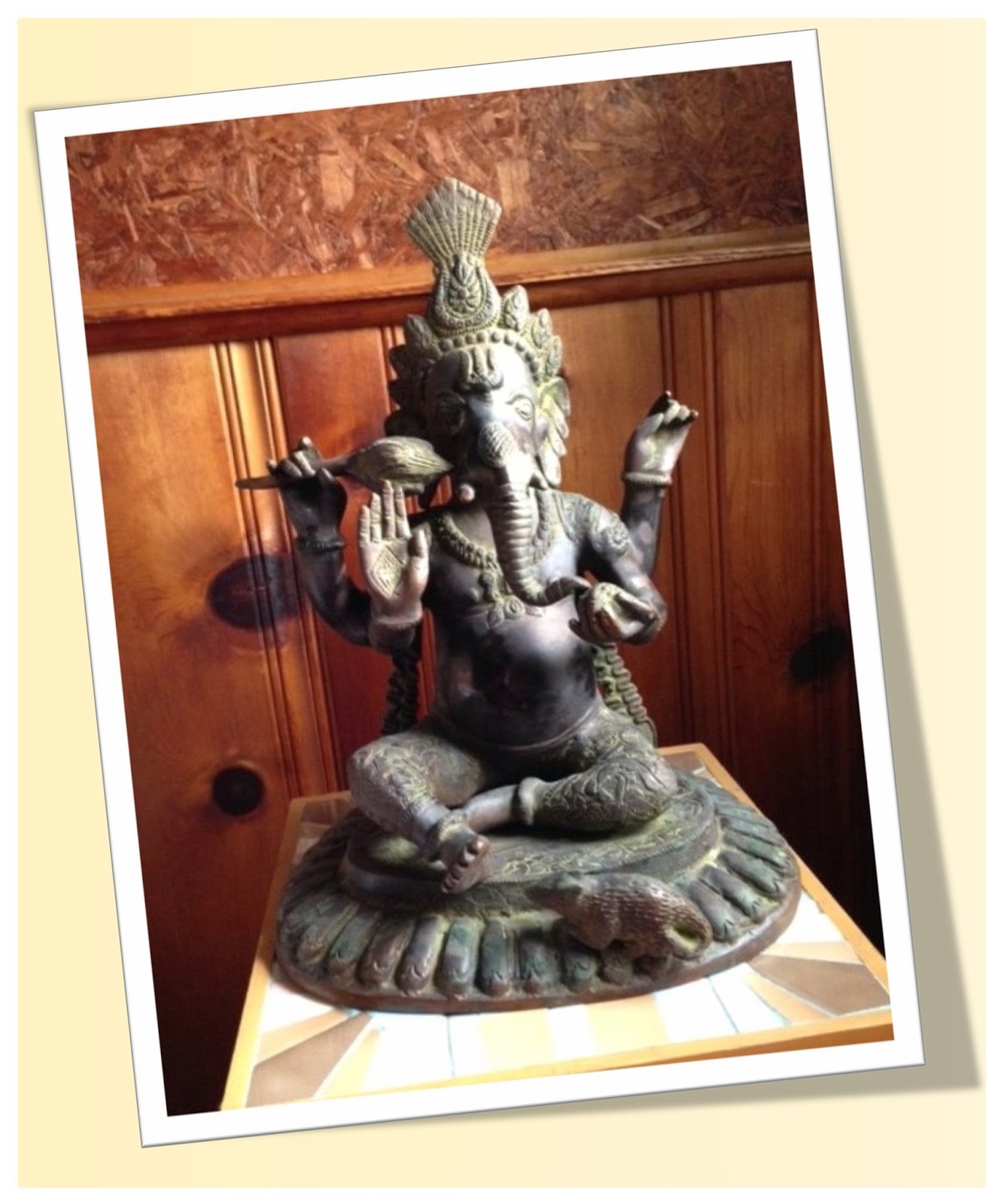
At the December BLESS-ED testimonial event, a church member presented Ed with a statue of Ganesh, a Hindu deity known as the Remover of Obstacles.
Ed placed Ganesh in a prominent place in our La Grange home where he could witness our final months' activities from a 360 degree vantage point. 
Ganesh looked out for us as.  He invited people to our curb so they could haul off junk. He led people into the house for giveaways. He sent Frank to carry boxes and load the POD. He tricked one of the pickers into leaving his industrial-sized packing tape dispenser on the kitchen counter. He dropped off empty boxes just when we needed more.  He found room on the back seat for a big TV, and then he fit everything else into the car.  He found my birth certificate and car title in a pile of rubble.
And it was Ganesh who handpicked Val and Silvano as our house buyers way back in October.  Because that’s when the obstacles began to melt.

Ganesh. Our Relocation Fairy.

EVS - 04/13

2/29/2012

ECHOES OF MARIAN HALL - Part Two

(NOTE to Reader: "Echoes of Marian Hall" is a serial story. Part One was posted in January, Part Two in February, and so on. Each part will make sense on its own, but it will make the most sense if you read them in order.  See the titles above.)

THEME: TAKING A LEAP
All growth is a leap in the dark, a spontaneous unpremeditated act without benefit of experience. ~ Henry Miller


I arrived home at four. The twenty-eight mile drive from Marian Hall hadn’t erased my agitation.  Katie hugged my knees; her world of joy reminded me of normal.
“So, how was it?” Ed asked.  “Do you love it there?”
“Where to start,” I said.  “Do we have any wine?”
After an hour of relating my day, Ed had it all figured out. “So these are troubled girls from dysfunctional homes who do something bad, go to court, get sent to live with other troubled girls from dysfunctional homes all in the same colorless, cinder blocked, stinky-bathroomed, linoleum-floored, musty-furnitured room of a dead-bolted apartment inside a locked institution surrounded by a chain link fence and watched over by a bunch of nuns who patrol the building clattering keys around their waists.”  He took a chicken out of the fridge and rinsed it under the faucet.  “Now that’s living.”  He slapped the chicken onto the cutting board. “What, exactly, did you expect?”
 “I don’t know – I didn’t think I’d care.  That it’s just a job?  Like babysitting?” 
Ed cut the legs off the carcass and sliced through the joints.
“El, these are locked-up teenage girls.  Did I mention dysfunctional?” He chopped off the wings.   “They’re not home making a chicken dinner with their moms and dads, who could probably give a flying fuck.” He winced and looked around for Katie, who lay under the kitchen table drawing circles on her steno pad, imitating Ed working on his graduate assignments.  “Right now they’re all in the same room, eating the same crap, knowing that tomorrow and tomorrow and tomorrow are going to be exactly as it is right this minute.  It’s not a happy place.”
Ed cracked the breastbone and hacked it into two sections.  He wiped blood off the fleshy pieces and threw them into a bag of seasoned cornmeal and flour.  White puffs danced as Ed shook the bag.  He dropped the pieces into a hot iron skillet, the sizzle reminding me of Sunday dinners at home in the Adirondacks.  Tender, crispy fried chicken, real mashed potatoes, smooth gravy—all expertly prepared by my mother who didn’t send me off to live in a reform school, no matter how disrespectful I was or how many curfews I broke.  But then I didn’t get caught shoplifting or running off with a man twice my age or sexually abusing the next-door neighbor’s kid in the woods.
Bottom line.  It wasn’t a happy place. 
“There’s something else,” I said. Grease splatted my hand. I made sure Katie was still under the table.
“What else?”
“I got a strange feeling – especially with Sister Pauline.  She scares them.”
“She’d scare me.”
“Gloria started to tell me about putting the girls in the hole. I think it’s a punishment room.”
“It’s probably just a time-out place.  Like the principal’s office.”
“They put the dispunkals in a hole?”  There she stood—right behind me, clutching her pencil and steno pad--innocence rising from her face.
It would be several days before I would give Ed a private update—where Katie’s budding mind wouldn’t absorb all the sadness.
* * *
On my second day, I worked the three o’clock shift. This time Diane, a veteran worker, would be on duty with me. She “kept things tidy,” according to Sister Pauline.  I pushed the doorbell and after a couple of minutes Marvin, the handyman, spoke through the intercom.  “Que voulez-vous?”  
“I’m Ellie Searl.”
“Qui?”
“Ellie Searl. I – je travail - work here – ici – dans Apartment One.” I held up a finger as if he could see it.
“Eh? Qui?” 
Was he deaf?  Didn’t he remember me? I wondered how long this would go on. I wondered when I’d get my own set of keys.
“Je suis . .Ellie . . . Searl.  . . . travail . . .  dans . . .  Apartment  . . . Une.”
Marvin let me in.  He laid a mop against the wall and motioned for me to follow him. “You come,” he said, and we headed toward Apartment One. 
Muffled screeching came from within the apartment as Marvin unlocked the door—like someone was screaming into a pillow. Marvin ignored the commotion and walked away. Once I was inside, shrieks reverberated off cinder block walls—a hen fight in an echo chamber.  A tall, dark-haired, burly woman—Diane, I assumed—stood between Greta and Marlene who were trying to hit each other. The other girls, fists air-punching, circled the fighters, egging them on, cheering—as if they had bets on the winner.  I had walked in on a teenage boxing match.
My first reaction was to leave. Quit. Right then. I hadn’t signed up for referee duty.
Sister Margaret was outside her small room, hands twitching at her sides.  “Someone should go get Sister Pauline,” she said when she saw me. I started toward the living room, but her shaking fingers clutched my sleeve. “Don’t get in the middle of that.  Please. Go get Sister Pauline.”
By that time, Greta had thrown Marlene to the floor and was trying to kick her, but she lost her balance and fell on top of her instead.  Diane dropped into the midst of it all to unglue the wrestlers. 
“You little bastard,” Greta said. “You took it—I know you did.”
“I’ll get Sister Pauline,” I yelled to Diane. 
Sister Margaret touched my arm and said, “Thank you, dear.”
 “No!” Diane shouted. “I’ll handle it.”
Sister Margaret shook her head. She had tears in her eyes. She went into her room and shut the door.
I stood there.  Like an idiot. Watching. Undecided.  Scared. Then I got mad. 
I moved in to the fight and bellowed. “STOP IT!  BOTH OF YOU! NOW!” I pointed at Marlene. “GET UP.”  I pointed at Greta. “YOU! SIT OVER THERE.”
Maybe it was pure novelty—the new worker having a fit, the one who the day before hadn’t made much of an impression.  Whatever the magic, the girls sunk into a kind of stupor.  Marlene and Greta rolled away from each other and stared at me.  I glared back and continued to point toward the couch.  “Move,” I said. Greta stood up and sank into the sofa. She stuffed her arms into a pretzel.   One of circling girls pointed at me and laughed. Marlene just lay there, panting.
“Well, haven't you got the touch.”  Diane sneered at me—as if I had stepped in her personal shit pile of responsibility.  “What else can you do? Raise the dead?” She got up and tucked her T-shirt back into her jeans. “I have my own ways.”
It wasn’t clear why she needed to demean me in front of the girls. Hadn’t I helped?  Wasn’t she the one who liked to “keep things tidy”?  But then, she had lost control—and I had found it. Her credibility had been put to question.  Apparently, I wasn’t building rapport with the veteran.
“You,” Diane gestured to Greta. “You’re outta here.”
Greta started to say something, but she must have thought better of it because she closed her mouth almost as soon as she opened it.
 Then Diane ordered the others to their rooms—doors open—until supper. No talking, no music, nothing. “Just sit on your beds and shut up.” Some mumbled stuff about it being unfair and that they hadn’t done anything. “Or you’ll all get the same,” Diane responded. That got them moving. Marlene giggled like it was all a game.
Diane stuck her face into Marlene’s. “You think this is funny? . . . Huh? . . . Answer me!”
Marlene shrunk back and shook her head.
“Yeah, I’ll bet you don’t,” Diane smirked. Somehow, she head managed to regain whatever distance had been lost—she was boss again.  And the girls understood whatever it was she wasn’t saying.
Diane turned her attention to me.  “You go patrol the upstairs,” she said in the same tone she had used with the girls. I felt reduced to underling status. “Make sure they follow the rules.  Take notes.”
“Where are you going?” I asked.
“Miss Kicker and I are taking a little trip to the zoo.” Diane grinned and cocked her head.  Her composure, and her control, all back together again.
I watched them go out of the apartment, Diane’s arm around Greta’s shoulder.  Had Greta’s head not been hanging, it would have appeared that Diane was leading a prized student to an award ceremony.
(Part Three - March)
EVS  02/12

1/15/2012

ECHOES OF MARIAN HALL - Part One

(NOTE to Reader: "Echoes of Marian Hall" is a serial story. Each part will make sense on its own, but it will make the most sense if you read them in order.  See story titles at the top of the blog.)


THEME: GOOD INTENTIONS
I may not have gone where I intended to go, but I think I have ended up where I intended to be. ~ Douglas Adams

I wonder if it smells the same. Rotting citrus. Meatloaf. Sour milk. Peanut butter. Disinfectant over vomit. Like an ignored school cafeteria.
Or if it sounds the same. Whispers, flushing toilets, sobs, pounding on metal doors, screams, record player needles scratching on forty-fives, keys clanking against the swish of black robes. 
I remember my last conversation with the director, Sister Mary Esther, who by that time was Jeanne Marie in street clothes, but to me she was still a Sister of the Good Shepherd, regardless of the switchover to secular management.  
***
She snorted. “It appears you don't like it here at Marian Hall.”
“I don't.” The words caught in phlegm. “There's too much chaos. It's dangerous. The girls aren't getting proper care.”
“Well, then,” she said, “there's no reason for you to stay. Go back to your area and get your things.” She opened a side drawer and rummaged around. I leaned in to get a peek at the rumored whiskey bottle, but she closed the drawer too quickly.
I wanted her to say it—to give me the exact reason, especially in the middle of my shift.
She looked up. “That's all,” she said. “You can go now.”
“Is there a particular reason . . . ?”
“I just told you.” She rolled back her chair and folded her arms. She looked strange in her green suit—less daunting, almost silly. “You don't like it here.” She rolled forward, picked up a pencil, and tapped it to punctuate each next word. “So you don't need to stay.”
“Then . . . it's not because . . . of something . . . .” I wanted to hear her say it.
 “Marvin will take you home if you don't have a car.” She handed me an index card. “Give your summer address to Sister Paul . . . ah, Bertha René, so we can send your final check.”
She slapped her hands on the blotter and stood up.   “One. More. Thing.” She leaned in.  “What, exactly, did you say to the social worker?”
Little pins pricked at my cheeks and into my chest. “Nothing,” I lied. “I didn’t say anything.” My face burned.
 “Nothing?  You sure?”
I shook my head like I had palsy—little jerky tremors. “Mm, mm,” my phlegm said.
It was July 14.  Bastille Day. And I no longer had a job at Marian Hall. I didn’t know whether to laugh or cry.
***
 The empty two-story brick building still sits at the end of Elm Avenue across the tracks from the Canadian-Pacific Railroad tracks in Beaconsfield, Quebec, twenty miles west of Montreal. In its last years, it was a middle-income rental retirement home until the owners kicked out the residents and closed its doors because it was too expensive to keep up. Before that, it was a youth protection home— a reform school, a locked institution for wayward, court-placed teenage girls—and I worked there.
It was July of 1971, and Ed, Katie, and I had just moved into our tiny Montreal apartment on Ridgewood Avenue, just off Côte-des-Neiges, practically across the street from the road to Parc du Mont Royal. Katie was three years old, Ed was about to begin his theological studies at McGill University, and I had found a job as a childcare worker at Marian Hall, an English speaking institution operated by the Sisters of the Good Shepherd. I was lucky. In 1971, on the tails of the FLQ (Quebec Liberation Front) crisis, Anglos, especially Americans, weren’t highly favored by the French and had difficulty finding work.
 My teaching experience would serve me well in this establishment. I’d never been to Catholic school, but I had heard about it. Structured, regulated, ordered, contained. I figured the Sisters would keep a tight rein on the place; all I’d have to do is hang out and babysit for eight hours. It didn’t bother me that it was shift work—seven to three during the day, three to eleven at night. No overnight shifts. Ed arranged his schedule around mine so finding a sitter for Katie was of little concern. It was perfect.
Sister Pauline interviewed me. She was a small, middle-aged, dark haired woman with a round, stoic face—hard to read. But I could tell from her questions she wanted someone who could retain credibility and build rapport with a bunch of disgruntled girls. She asked all about my teaching experience and seemed pleased with my answers, which apparently sounded strong and confident even though the place unnerved me—bleak, dismal, wrapped in a chain link fence.  
She told me what to expect when I started working. The girls would act as if they didn’t like me. They’d test my authority and talk back. “Expect sass,” she said. “They’ll want to get your goat right away. Remember, these girls were sent here by the courts for bad behavior. They’re from dysfunctional homes. They’re used to being pushed around.  They’ll resort to arguing—fighting—with anybody, especially if they think things aren’t fair—and things are never fair.”
“What are they in for?” I asked.
“Theft, threatening behavior, causing bodily harm, continually running away from home, sexual promiscuity, abuse—all kinds—both perpetrator and recipient. Pretty much any trouble a girl can get into—and get out-of-control while doing it. They’re usually just put on probation, but if they’re repeat offenders, or if the parents can’t manage them, the courts send them here.”
Sister Pauline unlocked the door to the apartment where I’d work.  “The main door to each of the three apartments is locked. The girls can’t get in or out without a key, and they don’t get keysever.”  She stopped and looked at me.  “That’s a big rule around here. Wear your keys around your neck under your shirt.”  Sister Pauline lifted her keys.  “I attach mine to my waist band and stick them in my side pocket.”
I already knew that.  She rattled when she walked.
 She guided me into the main hallway.  “Once you’re inside, no other room has locks – not any of them.  Except the medication office in the basement and Sister’s room just beyond the entrance here.  One Sister lives in each apartment.” She knocked on the door of a little room just off the hallway.  A petite elderly woman in a religious habit opened the door.  “Sister Margaret, this is Ellie Searl.  She’s the new childcare worker in the apartment. I’m showing her around.”
Sister Margaret smiled and put a soft, withered hand on my arm.  “So nice to meet you, dear.  I’m always here if you need anything.” Her eyes stayed on mine for an extra second, as if she wanted to say something else.  She didn’t look at Sister Pauline. “Well, have a nice visit.” And she shut the door.
 Each of the three apartments housed twelve girls and had a main floor, an upper floor, and a basement rec room.  This basement had two brown, vinyl couches, some shabby upholstered chairs, a ping-pong table, TV, record player, and an open cabinet strewn with board game pieces, playing cards, coloring books, note paper, crayons, pencils, magazines, and coverless paperbacks. Sister Pauline huffed and straightened the shelf. “Somebody’s not doing her job.”
At the back of the rec room were a two-stalled bathroom with no window and an office with glass walls.  “We keep all medications in here.”  Sister Pauline unlocked the door and the medication drawer. She brought out a folder.   “This has to be followed exactly.”  She tapped the folder and pointed to about fifteen bottles of medication.  “You dispense these pills every morning right after breakfast before the girls leave for their classes.  Never, ever remove the pills—or the files for that matter—from this room.  That happened once—about a year ago.”  She hesitated and stared into the drawer.  Her voice faltered.  “One of the girls saw the medication crate in the kitchen and snuck it to her room.”
She shook her head as if to bring herself back to the present.   “So . . . you must do all dispensing right here through that partition. Gloria, your apartment co-worker, will show you how it works when you start.”
“What happened to her? That girl.”
“Overdosed. Died.”
It was obvious I had more questions. What was the outcome? What about her family? How did the girls react? Who was in charge?  Did she or he get in trouble? but Sister Pauline held up her hand—like a stop sign. I closed my mouth.
She returned the folder.  “That’s why we don’t let the girls anywhere near this stuff.  And that’s why it’s locked.”
There were eight bedrooms on the upper floor, all painted a sad, dirty ecru, like the color bananas turn when left to rot.  I was surprised the beds were made and the clothes picked up.  I expected the rooms to reflect the inner chaos of unfortunate lives and frenzied personalities. 
She answered my thoughts. “They have to keep their rooms organized, or there are consequences. They don’t like the consequences.”
Sister Pauline led me into a single bedroom.  “Most of the girls share a room. The girls in singles are new and require more supervision.”  She smoothed the bed cover and walked out.  She didn’t see me rearrange the teddy bear that fell over. 
“Once they get the hang of being in close proximity to their housemates, the singles can upgrade to sharing when someone graduates, turns eighteen, or is sent to juvenile jail.” She caught my grimace. “Doesn’t happen often, but it happens. When they go home for a visit and get caught doing something really bad—like armed robbery.”
 The communal bathroom was a paint-chipped moss green with four graffiti-scratched toilet stalls, a row of sinks, and an open, separate shower room with three showerheads and a drain in the middle of the black and white tile floor. Privacy didn't seem to be a concern.  
The main floor was a large open room with a kitchen and another three-stalled bathroom at one end near Sister Margaret’s room. Near the kitchen were a couple of long tables with folding chairs. The living room section had two blue plaid couches, two vinyl brown recliners, and several ladder back chairs.   There were no rugs, no blankets thrown over the recliners, no pillows on the couch, no books, no color,  not even plastic flowers.  The lack of comfort screamed at me. Could I stand this place?  
It was too late to back out.  I had signed all the forms.  I would start in two days.
 I began on a morning shift. At first, everything seemed strangely serene. By 7:05 a.m., the girls were scuffling off to the bathroom. I tried to introduce myself, but they ignored me. Weeks later, I would learn that so many childcare workers had been in and out of their lives that a different face on the floor didn’t matter. I was just another authority figure. Just another bully to dole out consequences.
The girls went through their morning routine with robotic precision, like a choreographed dance—from ablutions to cold cereal to anti-depressant medication to classes. Their lack of chitchat seemed unusual in light of what Sister Pauline had told me. Because I was new, communication with the girls and the infrequent orders, “Make your bed,” or “Wash your bowl,” or “Take your pill,” came from Gloria. The girls didn’t respond much to Gloria nor Gloria to them. Her attitude seemed stiff and limp all at once, as if too much starch had been ironed into her spirit—or not enough. I couldn’t tell if she disliked the girls or flat-out didn’t care.
After the girls went off to class, Gloria and I sat at a dining table and went over the daily routine.  Girls got up at seven, dressed, ate breakfast, and went off to their classes in another part of the basement.  They came back for lunch at eleven, went back to classes until two, and returned to the apartment to have one glass of milk and two cookies at the dining tables, then do homework. Once homework was finished, they had free time to hang out in the rec room before and after dinner.  Down there they’d watch TV, dance to records, argue over whose noise was too loud, play cards, color, write letters, anything that kept them occupied until nine o’clock when they’d go up to their rooms for nine-thirty bedtime.  All planned out. 
The other rules were simple.
1.      Make beds; keep room neat.
2.      All girls on the same floor at the same times.
3.      No girls upstairs between breakfast and bedtime.
4.      Eating only at dining tables and only when scheduled—in assigned seats with assigned food.
5.      All homework signed by childcare worker.
6.      Chores done Friday afternoons on scheduled rotation—wash toilets, sinks, and shower area, mop floors and hallways, wipe tables and kitchen counters, dust furniture, clean out refrigerator, empty trash, straighten game shelf, wash windows, clean inside cabinets, sort and prepare personal laundry for weekly pickup by Sister Angela, the laundress.
7.      Dead silence at lights out.
On Saturdays, Sundays, and holidays, girls who didn’t go home to visit family spent the entire day in the basement doing rec room things or eating at the main room tables.  Gloria said they were the longest days.  “The hours really drag because there’s nothing for the girls to do. That’s when the arguing and fighting gets going.  You’ll have to be on your toes for that.” 
“Why don’t all the girls visit their families?”
“Some families don’t want them.  Or the girls are being punished.”
 “Punished for what?”
“Not making their beds. Going upstairs or onto another floor by themselves.  Stealing food. Talking back, especially to Sister Pauline. Doesn’t take much.”
“Talking back?  She said they always talk back.”
“Wait ‘til you find what will get them sent to detention—the hole.”
“What’s the hol. . .?
Sister Pauline unlocked the door and swished in.  “So, how are things?”  She didn’t wait for an answer.  “Is Gloria explaining everything to you?” She looked at the empty tables.  “Lunch will be here in a couple of minutes.  Got things all ready?” She raised her eyebrows and smiled at Gloria. Her voice sounded like melting treacle.
Gloria jumped up, grabbed silverware, plastic glasses, and napkins, and started setting the table. She motioned for me to help. 
“Good,” said Sister Pauline as she slammed the door behind her.
Lunch and dinner were prepared in a main kitchen and wheeled in on warming carts. The only foods kept in the apartment were breakfast items and snacks—cereal, milk, bread, crackers, peanut butter, jelly, fruit, and cookies.  All girls ate their meals and snacks on a rigid schedule, hungry or not.
I heard a commotion in the basement.
“The girls are here for lunch.  Brace yourself.”
A storm of humanity blew out of the stairwell and landed on the furniture.  Just then, the main door opened and in rolled a steel cart.   “Who’s on meals?” came from behind.
 “That’s Sister Eunice, one of the cooks,” Gloria whispered. “She’s a stitch.”
Two girls sauntered over. “Yuck,” said one.  “It’s salmonella craploaf again. With peas and jeez louise Jello.”  The two girls took plates of food out of the cart and placed them at the table settings.  The other girls, groaning in disgust, sat at their assigned places.
“Now, now, ladies,” said Sister Eunice. “I know you love it. You always eat it up.”
“’Cause we’re starving!” someone muttered.
“See you in a few.” Sister Eunice waved and left the apartment.
The meal was truly disgusting. Pale pink lumps played dead beside an oozing coagulant of mashed potatoes and beige gravy, sickly green peas, and a square of red Jello.
“What’s your name?” A girl across the table asked with her mouth full.
“Greta’s getting friendly,” someone sang in a na-na, na-na, naa-naa tone.
“Ellie,” I said.  “Ellie Searl.”
“Cereal?” Greta laughed.
“Ellie Bellie!”
“Hey, guys, it’s Ellie Bellie!”
I laughed. I had heard all this before, so it didn’t bother me too much.  At least they spoke to me.  Maybe letting them tease was the only way into their lives.
Gloria put the kibosh on the greetings. “You girls don’t want to be reported, do you?”
Silence.  Absolute silence.  They all went back to eating.  I was stunned.
“I’m from America,” I said, hoping to build some rapport.  “My husband goes to McGill. We have a little girl, Katie.  She’s three.”
“How nice for you,” Greta said.  “Can I leave the table?  I’m done.” She scraped back her chair. She had barely eaten anything.
I followed the routine the rest of that first day.  Snacks, homework, free time. All regulated. All very much controlled. I ended my shift at three o’clock and went home.  Exhausted.  Curious. Uneasy.  What was really going on at Marian Hall?
(Part Two - February)
EVS - 01/12